
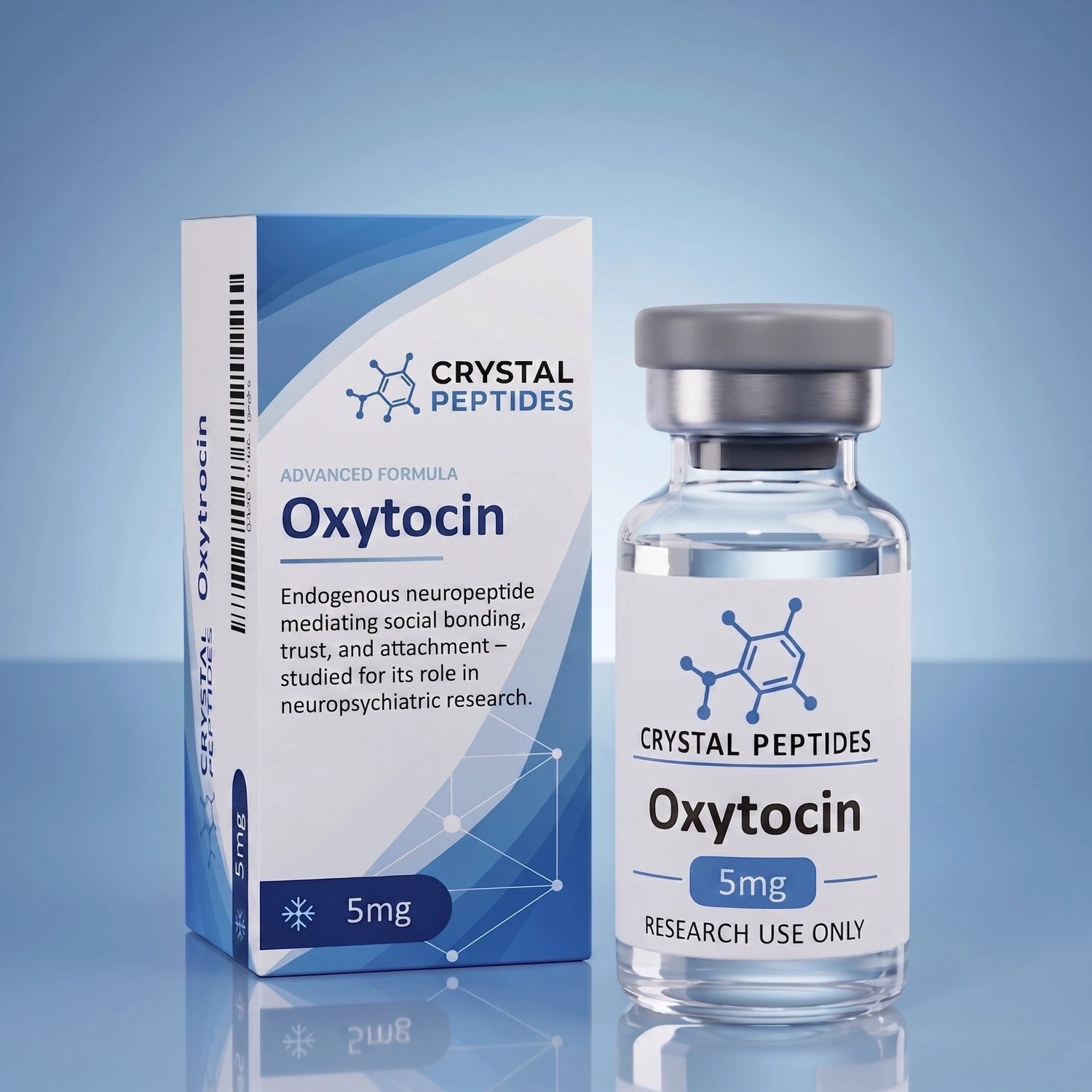
Oxytocin is supplied as a 5 mg catalogue research material. It is a cyclic, disulfide-bridged and C-terminally amidated nonapeptide used as a defined reference ligand in receptor, structural, peptide-folding and bioanalytical research.
Chemical properties and registry information
| Property | Value |
|---|---|
| Name and synonyms | OT, OXT, Pitocin, Syntocinon, alpha-Hypophamine |
| Material category | Neuropeptide Hormone |
| Sequence | H-CYIQNCPLG-NH2 (Disulfide bridge: C1-C6) |
| Molecular formula | C43H66N12O12S2 |
| Average molecular mass | 1007.19 g/mol |
| CAS Registry Number | 50-56-6 |
| PubChem CID | CID 439302 |
| Structural features | Cyclic nonapeptide with a disulfide bridge between Cys1 and Cys6, and a C-terminal amide. |
| Appearance | White to off-white lyophilised powder |
| Solubility | Soluble in water or bacteriostatic water. |
| Physical form | Catalogue vial; exact salt/counter-ion and excipients are batch-specific and must be verified in the CoA and SDS. |
Registry values apply only to the specific molecular entity, sequence, termini and material form. Batch records take precedence over family-level literature identifiers.
A neuropeptide hormone and medication used to cause contraction of the uterus and for lactation. It also plays a role in social bonding and behavior.
Research background and published evidence
Published research
Oxytocin has been investigated as a defined ligand in receptor-binding and signaling studies, structural analysis and peptide-chemistry research [1,3,4]. Interpretation requires confirmation of the nine-residue sequence, Cys1–Cys6 bridge, terminal amide, purity and exact material form.
Current scientific understanding
Literature and pharmacopoeial records describe defined oxytocin materials but do not authenticate an individual catalogue batch. Findings for arginine vasopressin, oxytocin analogues or formulated medicinal products are not directly transferable without analytical comparability [2].
Technical comparison
| Aspect | Oxytocin | Arginine vasopressin |
|---|---|---|
| Identity | Amidated nonapeptide with a Cys1–Cys6 disulfide ring | Related amidated disulfide nonapeptide with sequence differences |
| Structural distinction | Contains Ile3 and Leu8 in the human oxytocin sequence | Contains Phe3 and Arg8 |
| Analytical implication | Confirm sequence, intact mass, disulfide connectivity, C-terminal amidation, purity and material form | Receptor activity alone does not establish oxytocin identity |
Quality and testing
Quality information is batch- and presentation-specific. Use only a report linked to the exact size and lot.
Chromatographic purity, molecular identity, net peptide content, water or counter-ion content, sterility, endotoxin and elemental impurities are different measurements. One result does not establish the others.
Laboratory handling and storage
Store and handle under the conditions stated on the product label, matching CoA and SDS. Protect the material from contamination and do not infer stability from a related peptide or formulation.
Laboratory preparation, analytical-method selection, risk assessment, personal protective equipment and waste disposal should follow the applicable SDS and the institution’s approved procedures.
Regulatory and legal status
| Research-use notice | This material is supplied exclusively for laboratory research by qualified professionals and is not intended for human or veterinary use. Purchasers are responsible for compliance with applicable local requirements. |
Sources and references
- [1] PubChem CID 439302 — Oxytocin.
- [2] International Pharmacopoeia — Oxytocin monograph.
- [3] Journal of the American Chemical Society — synthesis and structure of oxytocin.
- [4] Science Advances — structural study of oxytocin-receptor recognition.
Frequently Asked Questions
Do the CAS number and PubChem CID apply to every form?
Only when the exact sequence, disulfide connectivity, terminal amide, salt or counter-ion and hydration state match the batch material.
What does an analytical purity result mean?
It is method- and report-specific. An HPLC area percentage does not by itself establish identity, net content or the other quality attributes listed above.
How should the material be stored and handled?
Follow the exact label, batch CoA and SDS together with the institution’s risk assessment.