
TB 500
$32.00 – $57.00Price range: $32.00 through $57.00
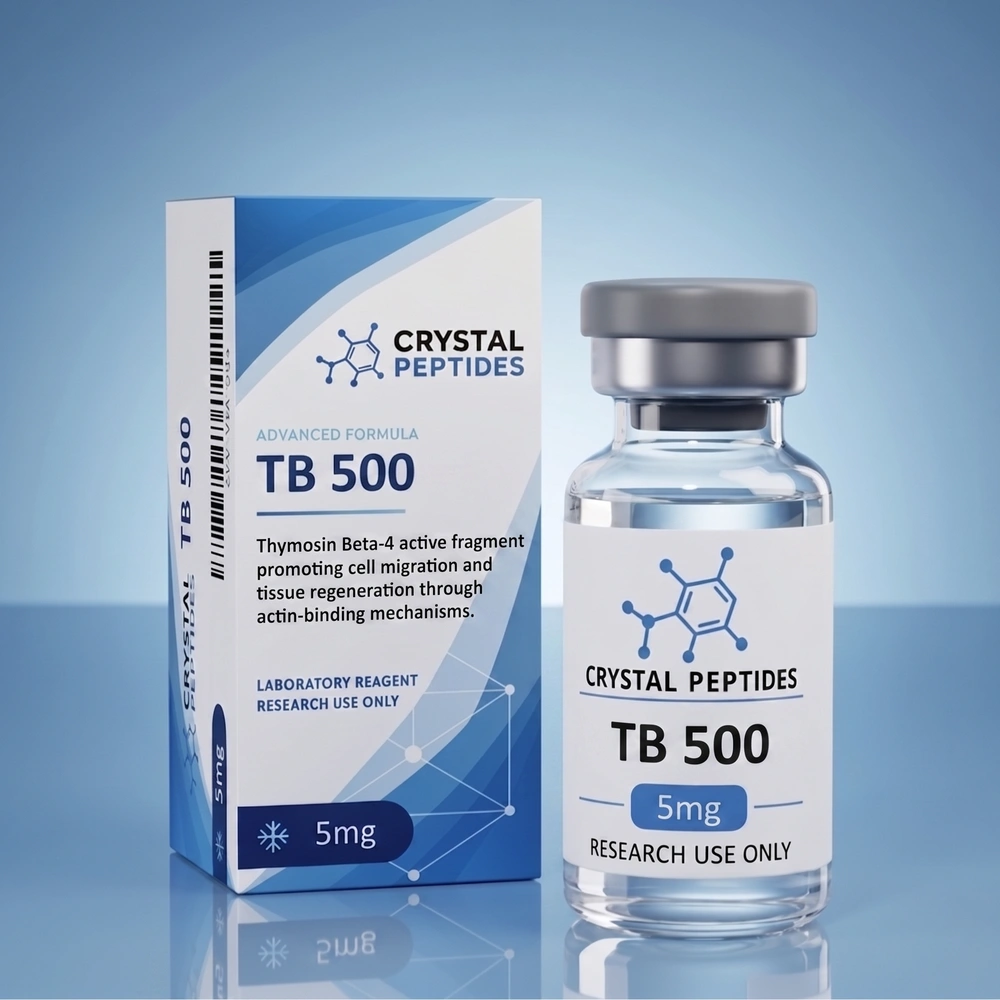
TB 500 is supplied as a catalogued research material in 5 mg and 10 mg.
Current FDA chemistry review supports TB-500 as N-acetyl thymosin-β4(17–23), Ac-LKKTETQ. The market name is nevertheless used inconsistently for the acetylated fragment, non-acetylated LKKTETQ, salt forms and even full-length thymosin-β4. Registry values are conditional on sequence, N-acetylation and counter-ion confirmation [1–3].
Chemical properties and registry information
| Property | Value |
|---|---|
| Name and synonyms | Thymosin Beta-4 (1-43), Timbetasin, RGN-259 |
| Material category | Wound Healing & Tissue Repair |
| Sequence | Ac-SDKPDMAEIEKFDKSKLKKTETQEKNPLPSKETIEQEKQAGES |
| Molecular formula | C212H350N56O78S |
| Average molecular mass | 4963.49 g/mol |
| PubChem CID | CID 71307141 |
| Structural features | Synthetic N-acetylated fragment (residues 1-43) of the protein Thymosin Beta-4. Contains the actin-binding motif LKKTET. |
| Appearance | White to off-white lyophilised powder |
| Solubility | Soluble in bacteriostatic water or sterile water. |
| Physical form | Catalogue vial; exact salt/counter-ion and excipients are batch-specific and must be verified in the CoA and SDS. |
Registry values apply only to the specific molecular entity, sequence, termini and material form. Batch records take precedence over family-level literature identifiers.
TB-500 is a synthetic 43-amino acid fragment of the naturally occurring protein Thymosin Beta-4 (Tβ4). It retains much of the biological activity of the parent protein, particularly in promoting cell migration, wound healing, and reducing inflammation.
Research background and published evidence
Published research
Defensible contexts are LC–HRMS identity and metabolite analysis and assays performed directly with sequence-confirmed Ac-LKKTETQ. Fragment-specific results must be separated from literature on full-length thymosin-β4 or non-acetylated LKKTETQ [1–3].
Current scientific understanding
FDA found no human administration studies for TB-500, and evidence for non-acetylated LKKTETQ or full-length thymosin-β4 cannot be transferred automatically. No clinical or human-use inference is appropriate.
Technical comparison
| Aspect | This catalogue material | Comparator |
|---|---|---|
| Identity | TB-500, conditionally defined as Ac-LKKTETQ | Full-length thymosin-β4, a separate 43-residue peptide |
| Structural distinction | Seven-residue N-acetylated fragment | Full 43-residue primary structure |
| Analytical implication | Confirm Ac-LKKTETQ sequence, N-acetylation and salt | Distinct intact mass, impurity profile and reference standard |
Quality and testing
Quality information is batch- and presentation-specific. Use only the report linked to the exact size and lot. A report listed for another size, lot or similarly named material must not be treated as evidence for this product.
Chromatographic area purity, identity, net peptide or analyte content, water or counter-ion content, sterility, endotoxin and elemental impurities are different measurements. One result does not establish the others. Only tests supported by a visible, matching report should be regarded as available.
Laboratory handling and storage
Store and handle only under the conditions stated on the product label, batch CoA and SDS. Keep the container secured, correctly identified and protected from contamination. Do not infer storage, solvent compatibility or stability from a related compound.
Laboratory preparation, analytical-method selection, risk assessment, personal protective equipment and waste disposal should follow the applicable SDS and the institution’s approved procedures.
Regulatory and legal status
| Research-use notice | This material is supplied exclusively for laboratory research by qualified professionals and is not intended for human or veterinary use. Purchasers are responsible for compliance with applicable local requirements. |
Sources and references
- [1] U.S. FDA. 2026 briefing document for TB-500.
- [2] PubChem. N-acetyl thymosin-β4(17–23) compound record.
- [3] Primary analytical identification of TB-500. Drug Testing and Analysis.
Frequently Asked Questions
Do the CAS number and PubChem CID apply to every batch form?
Only when the exact sequence or structure, termini, conjugation, salt or counter-ion and hydration state match. The batch CoA and SDS govern; a related-compound identifier must not be substituted.
What does an analytical purity result mean?
It is method- and report-specific. For example, an HPLC area percentage is not automatically the same as identity, net content, sterility, endotoxin status or absence of elemental impurities.
How should the material be stored and handled?
Follow the exact label, batch CoA and SDS together with the institution’s risk assessment. Use only storage and stability information linked to the exact material form and batch.